
432 products
432 products
Sort by:
$65.99
Unit price perOTA Programmer is a module which adopted the BT communication technology for transferring data between an ESC and a smart device (Android phone, tablet, and etc). It makes the wireless communication between ESC and smart device possible; the user can easily program and upgrade ESC and monitor data transferring via this unit.
Works with the following products of HOBBYWING.
- Some of XERUN series & EZRUN series of car ESCs.
- Some of PLATINUM series of aircraft ESCs.
- Some of SEAKING series of boat ESCs.
- For details, please refer to ESC manual to ensure if the ESC can work with OTA Programmer.
$124.99
Unit price perExcellent performance, specially designed for 1/10 STOCK racing.
Designed to pair with HOBBYWING XR10 Stock Spec G2 ESC
The innovative outer diameter structure of fully exposed stator core maximizes the heat dissipation area and the rear end of the motor is a big opening structure to further improve the heat dissipation effect.
Dual sensor interface design to meet various wiring/layout requirements.
The special copper bar is customized and the spacing of copper bar is widened, which greatly facilitates the operation of soldering wire.
The built-in high precision Hall sensor combined with the high precision and balanced rotor guarantee outstanding linearity of the motor.
The use of high-performance stator core, 220°C high-temperature-resistant enameled wire, high precision and high strength bearings, and copper solder tabs with super current endurance guarantees outstanding
$209.99
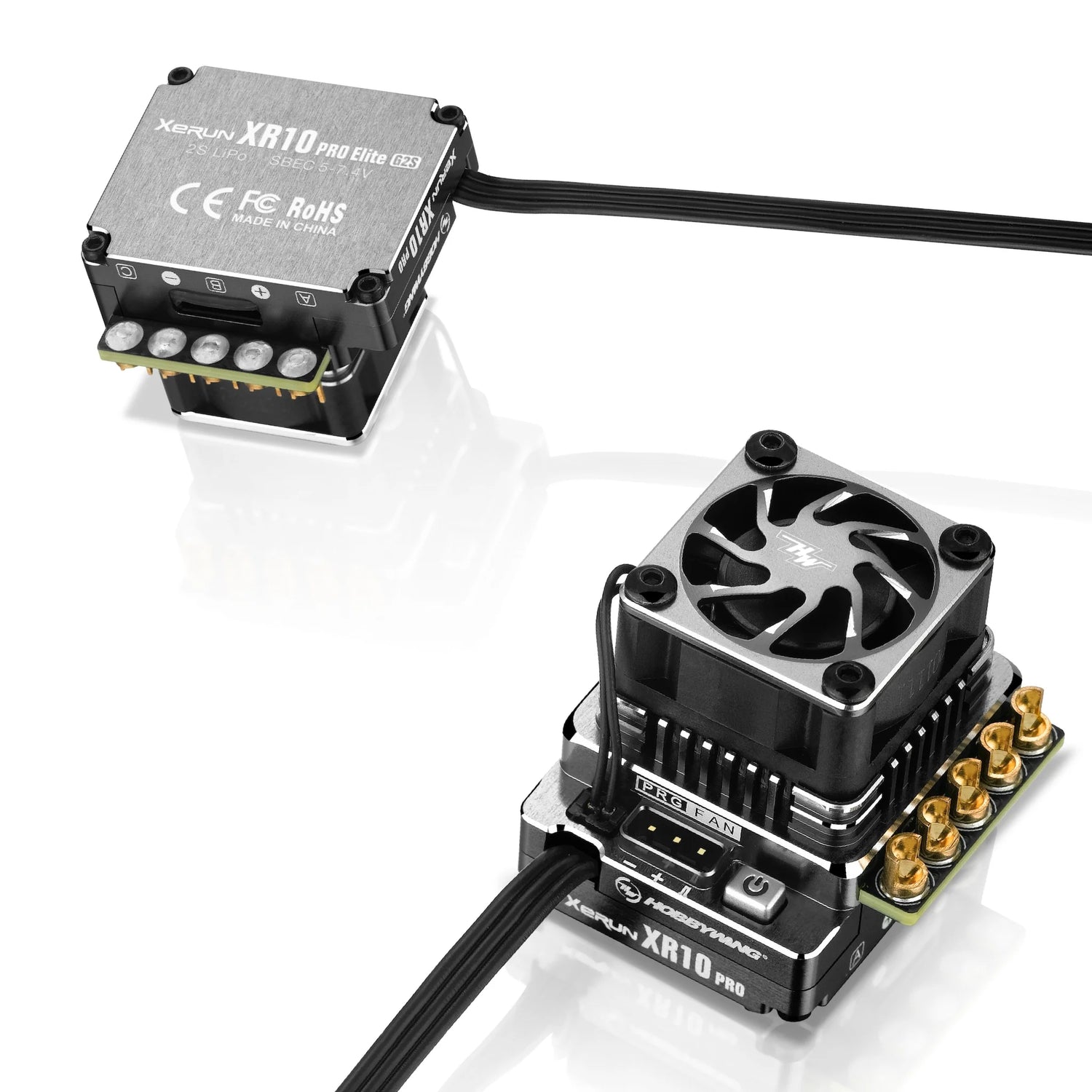
Unit price perIf your 1/10 race car feels like the throttle is being translated through a committee, the ESC is usually suspect number one. The HOBBYWING XERUN XR10 Pro G2S Elite 160A sensored brushless ESC is made for drivers who want cleaner throttle response, stronger brake tuning, and more useful setup control in a compact 2S racing package.
This Elite G2S unit is rated for 160A continuous and 1200A peak current, with support for sensored and sensorless brushless motors. It fits the serious 1/10 crowd - touring car, buggy racing, drift, and F1 - and HOBBYWING recommends 4.5T or higher motors for touring and 5.5T or higher for buggy. In other words, check your class rules before you let the timing settings form a tiny weather system.
We like the practical details here: 13 AWG 200mm wires, a 37.5x30.9x32.5mm case with fan, adjustable 5-7.4V BEC, LCD program box and OTA programmer support, firmware upgrade support, and data logging when used with the proper HOBBYWING setup gear. The Elite version uses a normal framed fan rather than the Stealth version's frameless fan, and it is not waterproof. No pre-installed connectors, because apparently soldering irons still need hobbies too.
Quick Specs:
- Brand: HOBBYWING
- Model: XERUN XR10 Pro Elite G2S
- Manufacturer product number: 30112617
- Type: 1/10 scale brushless ESC
- Motor type: Sensored and sensorless brushless motors
- Waterproof rating: No
- Applications: 1/10 touring car and buggy racing, 1/10 drift car, F1
- Continuous/peak current: 160A/1200A
- Input voltage: 2S LiPo / 4-6 cell NiMH
- BEC output: 5-7.4V adjustable; official table lists 5A, while official feature copy notes a 10A maximum
- Recommended motor limit: 1/10 touring car 4.5T or higher; 1/10 buggy 5.5T or higher
- Programming support: LCD program box and OTA programmer
- Firmware update support: LCD program box via USB software on PC, or OTA on iOS/Android
- Input wires: Black 13 AWG 200mm x2
- Output/phase wires: Black 13 AWG 200mm x3
- Input connectors: Not included / not installed
- Output connectors: Not included / not installed
- Fan type: Normal framed fan
- Fan size: 25x25x10mm
- Fan power: 5-7.4V, powered by BEC
- ESC size: 37.5x30.9x32.5mm with fan
- Weight: 88g with wires; 50.21g without wires
- Data recording: Extreme value, real-time data, and historical graph support
- Included items verified by retailer listing: ESC, cooling fan, capacitors, decals, accessory package
Seamless Connectivity. Used with the OTA wireless device and your smart device, you can unlock the true potential of your tuning abilities. View data logs, check real-time data and adjust any and all parameters of your ESC.
- Very high accuracy barometer built-in to the receiver to provide altitude and vario information
- True Full-range diversity telemetry provides plane information in real-time as far as you can fly your plane with any DSMX or DSM2 compatible transmitter
- Energy metering system (mAh, V, Current) are included with the provided V/I sensing unit
- 2-stage failsafe suited for gasoline / electric applications (Selectable failsafe for pre-defined position as throttle only or all channel failsafe in the event of signal loss)
- Diveristy extended antenna receiver with state-of-the-art RF circuit providing unmatched reception
- Real time RSSI output as analog voltage / displayed on transmitter A parameter
- Glider may use the included wiring for battery voltage sensing only if energy metering system is not required for absolute weight reduction
- Optional diversity satellite maybe used to provide total of 4 receiving antennas
- Included sensors / interface: Altitude, Vario, Energy meter (Receiver voltage, Battery voltage, mAh consumed, Current),
- Temperature (Internal automatically selected when the included external temperature probe is not used),
- RSSI out (3V to 0V) and displayed on transmitter A parameter
Specifications:
- Type: Lemon RC DSMP (DSMX Compatible) 7-Channel Full-Range Telemetry receiver with diversity receiver (Vario + Energy Meter + Altitude)
- Channels: 7
- Modulation: DSMP (DSMX & DSM2 compatible)
- Band: 2.4GHz
- Dimensions: 44(L) x 24(W) x 15(H)
- Weight: 9.56g
- Voltage Range: 4.5-8.5V
Note:
1) This is not a Spektrum DSMX or DSM2 product, nor is it a copy of a Spektrum DSM2 or DSMX product. The Spektrum, DSMX and DSM2 brand is a trademark of Horizon Hobby, Inc.
2) This is not an underground black market fake Spektrum product. Lemon Rx quality is guaranteed.
3) Lemon Rx products are tested to be compatible with Spektrum's DSMX and or DSM2 product (Spketrum, DSMX and DSM2 are the registered trademark of Horizon Hobby, Inc.).
DSMP 6-channel receiver is DSMX/DSM2 compatible that provides exceptional performance.
Specifications:
- Dimensions: 42x23mm
- Weight: 2.3g
- Voltage Range: 3.5V to 8.5V (2S LiPo compatible)
- Technology: DSMP with GEN2 SDR stack (DSMX / DSM2 Compatibility)
1S LiPo Application
The minimum recommended safe supply voltage is 3.5V
NOTE:
-
The battery must be capable of maintaining that voltage while delivering the required maximum load current to the receiver and servos. In some cases you MAY be able to operate at a lower voltage (for example a well discharged 1S LiPo cell) but you must test it in practice to be sure.
Lemon RX products are tested to be compatible with Spektrum's DSMX and or DSM2 product (Spektrum, DSMX and DSM2 are the registered trademark of Horizon Hobby, Inc.).
The generation 2 DSMP 7-channel telemetry stabilizer is a complete redesign that provides the ultimate reliability, features and performance.
- DSMX / DSM2 compatible, 7-channel full-range telemetry stabilizer with full telemetry features including a built-in barometer, altimeter, energy meter (Current, Voltage, mAh), and internal temperature sensor
- High sensitivity gyro with proprietary stabilization algorithm ensures responsive airplane control for both electric and gasoline engine application
- BEC1 and BEC2 dual inputs allow high-reliability operation while improving setup for high current drain performance servo
- Built-in Delta, V-tail and Normal Wing mixer
- Supports stabilization with separated channel dual aileron operation
- Stabilization always-on feature
- Real-time variable stabilization gain control on channel 8
- All-channel failsafe
- Firmware health monitoring software stack and ultra-low operational voltage (3.6V) ensure the highest hardware reliability
- Generation 2 SDR stack ensures the fastest channel searching and advanced algorithm for signal recovery with ultra-low-latency experience
- Antenna diversity improves the reliability of the wireless link
- Satellite port for additional signal diversity
- Gyro stabilization activation with either AUX2 or Gear channel
- 3 potentiometers for individual gain tuning
User manual (See http://www.lemon-rx.com/manual Quick Reference Guide)
- Reset stabilizer
- Connect power
- Hold F and B buttons (approximately 5 secs+) until all LED flashes randomly
- Press the C button. Multiple LEDs flash a few times to complete the operation
- Bind with bind plug
- Insert bind plug on Channel 7
- Connect power
- Bind without bind plug
- Connect power
- Hold the B button until the red LED flashes
- Bind with a satellite without a bind plug
- Connect power
- Hold the B button until the red LED flashes
- Disconnect power
- Plug the satellite wire connector into the stabilizer
- Connect power
- Failsafe
- Connect power to the receiver and ensure the servos are working with the transmitter
- Press the F button for 3 seconds until green changes from off to on and vice versa to change the failsafe setting. Channel value is saved as failsafe default at the time the green LED turns on.
- Turn off the transmitter and wait 2 seconds to ensure the failsafe is activated accordingly by ensuring there is torque generated with finger-pushing the servo linkage if it was to be set. Vice versa.
- Stabilization activation switch
- Disconnect power
- Insert bind plug to channel 5
- Hold the C button
- Connect power. Wait for about 1 second until the 6 LEDs flash.
- Release the C button
- Press C to make changes within 3 seconds. Green = CH7, Blue = CH5.
- Wait for 3 seconds and remove the bind plug
- Wing Mode and Dual Aileron
- Disconnect power
- Insert bind plug to channel 6
- Hold the C button
- Connect power. Wait for about 1 second until the 6 LEDs flash
- Check the receiver label/user manual to understand the referred LEDs' operation
- Release the C button
- Observe which red LED is flashing and brief press C to select the required mode
- Press C to toggle between settings. On means selected. Exit automatically in 5 seconds.
- Wait for 3 seconds and remove the bind plug
- Ensure transmitter mixing is set accordingly for dual aileron if stabilized dual aileron is to be configured.
- Gyro direction
- Check the receiver label/user manualto understand the referred LEDs' operation
- Connect power and wait 1 second
- Hold the C button and wait for about 1 second until the 6 LEDs flash
- Release the C button
- Observe which red LED is flashing and brief press C to select the required mode
- Press C to toggle between settings. On means selected. Exit automatically in 5 seconds.
- Wait for 3 seconds and remove the bind plug.
- V/I sensor calibration
- Turn on the receiver and transmitter. The telemetry report page may optionally be checked during and after calibration.
- Plug the V/I sensor. Make sure the required DC loading device such as a brushless motor with ESC as well as the current and voltage meter is connected.
- Press the F and B buttons together at the same time for 2 seconds but no greater than 5 seconds
- Observe 3 green LED flashes. Ensure 8.4V is provided to the V/I sensor.
- Press F or C button briefly
- Observe 3 red LED flashes
- Turn on the DC loading device by throttling the transmitter. Ensure 4A is drawing across the V/I sensor. Be careful with the motor spinning if it is to be used.
- Press the B button to save and exit.
- V/I probe calibration
- Turn on the receiver and transmitter. The telemetry report page may optionally be checked during and after calibration.
- Plug the V/I sensor. Make sure the required DC loading device such as a brushless motor with ESC as well as the current and voltage meter is connected.
- Press the F and B buttons together at the same time for 2 seconds but no greater than 5 seconds
- Observe 3 green LED flashes. Ensure 8.4V is provided to the V/I sensor.
- Press F or C button briefly
- Observe 3 red LED flashes
- Press the B button to save and exit.
- Gain setting
- Adjust via the 3 dials or real-time master gain on channel 8 depending on the transmitter channel's availability.
- View setting LEDs with all on
- Press the C button briefly (no more than 2 seconds).
Lemon Rx products are tested to be compatible with Spektrum's DSMX and or DSM2 product (Spektrum, DSMX and DSM2 are the registered trademark of Horizon Hobby, Inc.).
- High sensitivity gyro with proprietary stabilization algorithm ensures responsive airplane control for both electric and gasoline engine application
When your aircraft needs more than a basic receiver, bolting in a separate stabilizer, telemetry sensor and voltage monitor can turn a clean install into a tiny wiring swamp. The Lemon RX LM0087XT60X keeps the important bits in one compact DSMP 10-channel telemetry stabilizer receiver with an XT60 energy meter, built for DSMX/DSM2 compatible RC aircraft setups.
It gives you full-range control, gyro stabilization, telemetry, and flight-pack energy monitoring in a 16.3g unit measuring 66x15x24mm. The built-in barometer supports altitude and varios telemetry, while the XT60 V/I sensor setup reports flight-pack voltage and current up to 5S LiPo / 21V max and 60A max. Useful information, less guesswork, fewer post-flight battery autopsies.
The LM0087XT60X also supports normal, delta and V-tail mixing, separated dual aileron stabilization, all-channel failsafe, dual BEC inputs, antenna diversity, an optional satellite port, channel 8 real-time gain control, and three onboard gain pots. Receiver power range is 3.9V to 8.5V, so it fits common BEC and receiver battery setups without needing a doctorate in small wires.
Lemon Rx products are tested to be compatible with Spektrum's DSMX and or DSM2 product (Spektrum, DSMX and DSM2 are the registered trademark of Horizon Hobby, Inc.).
Quick Reference Guide
Reset stabilizer
- Connect power
- Hold F and B buttons (approximately 5 secs+) until all LED flashes randomly
- Press the C button. Multiple LEDs flash a few times to complete the operation
Bind with bind plug
- Insert bind plug on Channel 10
- Connect power
Bind without bind plug
- Connect power
- Hold the B button until the red LED flashes
Bind with a satellite without a bind plug
- Connect power
- Hold the B button until the red LED flashes
- Disconnect power
- Plug the satellite wire connector into the stabilizer
- Connect power
Failsafe
- Connect power to the receiver and ensure the servos are working with the transmitter
- Press the F button for 3 seconds until green changes from off to on and vice versa to change the failsafe setting. Channel value is saved as failsafe default at the time the green LED turns on.
- Turn off the transmitter and wait 2 seconds to ensure the failsafe is activated accordingly by ensuring there is torque generated with finger-pushing the servo linkage if it was to be set. Vice versa.
Stabilization activation switch
- Disconnect power
- Insert bind plug to channel 8
- Hold the C button
- Connect power. Wait for about 1 second until the 6 LEDs flash.
- Release the C button
- Press C to make changes within 3 seconds. Green = CH7, Blue = CH5.
- Wait for 3 seconds and remove the bind plug
Wing Mode and Dual Aileron
- Disconnect power
- Insert bind plug to channel 9
- Hold the C button
- Connect power. Wait for about 1 second until the 6 LEDs flash
- Check the receiver label/user manual to understand the referred LEDs' operation
- Release the C button
- Observe which red LED is flashing and brief press C to select the required mode
- Press C to toggle between settings. On means selected. Exit automatically in 5 seconds.
- Wait for 3 seconds and remove the bind plug
- Ensure transmitter mixing is set accordingly for dual aileron if stabilized dual aileron is to be configured.
Gyro direction
- Check the receiver label/user manual to understand the referred LEDs' operation
- Connect power and wait 1 second
- Hold the C button and wait for about 1 second until the 6 LEDs flash
- Release the C button
- Observe which red LED is flashing and brief press C to select the required mode
- Press C to toggle between settings. On means selected. Exit automatically in 5 seconds.
- Wait for 3 seconds and remove the bind plug.
V/I sensor calibration
- Turn on the receiver and transmitter. The telemetry report page may optionally be checked during and after calibration.
- Plug the V/I sensor. Make sure the required DC loading device such as a brushless motor with ESC as well as the current and voltage meter is connected.
- Press the F and B buttons together at the same time for 2 seconds but no greater than 5 seconds
- Observe 3 green LED flashes. Ensure 8.4V is provided to the V/I sensor.
- Press F or C button briefly
- Observe 3 red LED flashes
- Turn on the DC loading device by throttling the transmitter. Ensure 4A is drawing across the V/I sensor. Be careful with the motor spinning if it is to be used.
- Press the B button to save and exit.
V/I probe calibration
- Turn on the receiver and transmitter. The telemetry report page may optionally be checked during and after calibration.
- Plug the V/I sensor. Make sure the required DC loading device such as a brushless motor with ESC as well as the current and voltage meter is connected.
- Press the F and B buttons together at the same time for 2 seconds but no greater than 5 seconds
- Observe 3 green LED flashes. Ensure 8.4V is provided to the V/I sensor.
- Press F or C button briefly
- Observe 3 red LED flashes
- Press the B button to save and exit.
Gain setting
- Adjust via the 3 dials or real-time master gain on channel 8 depending on the transmitter channel's availability.
View setting LEDs with all on
- Press the C button briefly (no more than 2 seconds).
This is the Leopard Version 2.0 18A Sensorless Brushless ESC. A great speed control for your 1/18 scale mini or micro RC, comes equipped with a mini-Tamiya style plug for battery conenction and 3.5mm bullet terminals for motor connection.
Features:
- Compatible with sensorless brushless motors.
- High quality components
- Excellent start-up, acceleration and linearity features.
- Plenty of programmable items
- Multiple protection features: Low voltage cut-off protection / Over-heat protection / Throttle signal loss protection.
- Internal timing can be changed easily
- Easily programmed with the SET button or LED Program Box
Specifications:
- Output: Continuous 18A, burst 50A.
- Input: 4-9 cells NiMH/NiCd or 2-3S LiPo.
- BEC: 6V/1A (Linear mode built-in BEC).
- Resistance: 0.01 Ohm.
- Motor Supported: Sensorless Brushless Motor.
- Suitable Motor: With 4-6 cells NiMH/NiCd or 2S Lipo: On-Road≥12T, Off-Road≥8T; With 6-9 cells NiMH/NiCd or 3S Lipo: On-Road≥18T, Off-Road≥24T;
- Suitable Car: 1/18 on-road sport.
- Cooling Fan: Not included.
- Size: 31.5mm(L) * 27.5mm(W) * 15mm(H).
- Weight: 19g (Without wires)
Includes:
- (1) 18A ESC
- (2) Zip-ties
- (2) Shrink-tubing
- (1) Double-sided tape
- (1) Instruction manual
The Leopard 4092 is a crazy long, crazy powerful motor. Can be used in anything from 1/8 vehicles, lightweight 1/5 scale rigs and large boats. Check your clearance before ordering!
Leopard motors are built using the highest grade components for outstanding performance and long life. The latest generation 4-pole rotors provide massive torque, and are Kevlar wrapped to ensure the magnets stay put at all RPM’s. All components are precision machined, balanced and hand-built to guarantee quality, and with an extensive product line including many sizes you just won’t find from other manufacturers you are sure to find a Leopard motor to fit your application.
Features:
- Precision machined aluminum housing
- Kevlar wrapped, 4-pole rotor
- Imported high-speed Japanese bearings
- Hand wound stator, using high-purity/high-temperature copper wire
- Excellent heat dissipation
